Ecosia
It's... complicated.

You may have heard of Ecosia. If you haven't, they are an organization that has both a browser and a search engine that uses their profit to plant trees and to donate to climate action. I love what they're doing and almost everything they stand for, yet I do not use Ecosia personally or recommend them on the site. It may seem that a recommendation from this site for Ecosia would be a no-brainer. Their goals align with the sites 1 to 1. This site is about using ethical alternatives to big tech, and what's more ethical that planting trees? Sadly, I believe that it's not that simple. Let me explain why.
They aren't bad
First, let me say this. Generally, Ecosia isn't lying. They aren't bad actors. At least, I don't believe they are. They do actually do all the good things that they say they do (Ecosia, B Lab, Owens). They are pretty transparent, especially with their finances (Ecosia). I believe that the people at Ecosia and the organization in general all have good interests at heart. This isn't a hit piece, and I'm not going to claim that they're evil or frauds or PSYOPs or something. I think they are a noble company that has a positive impact on the world. Rather, my concerns with the group lies with how effective they are and with their implementation of AI.
Ecosia's AI
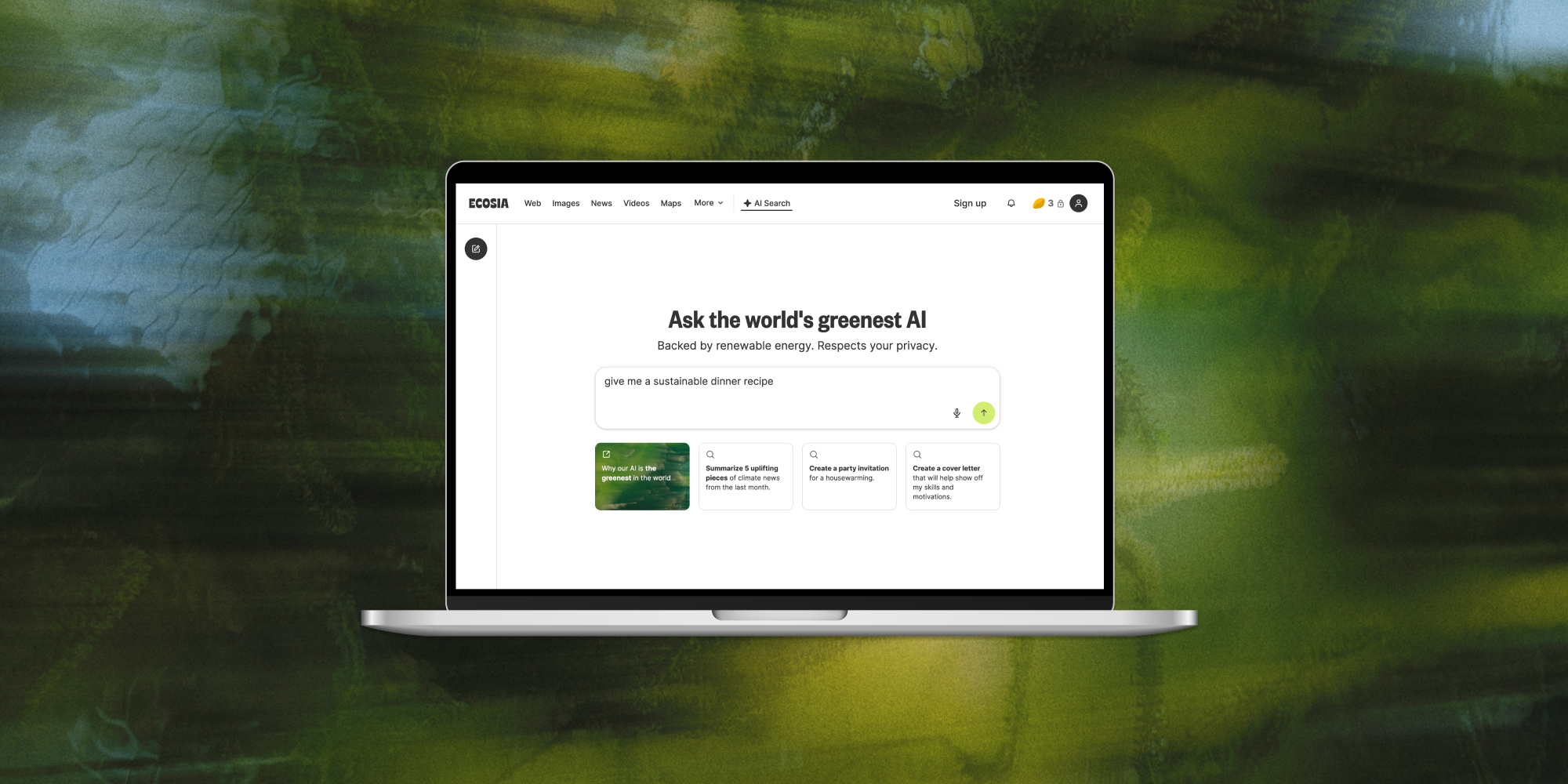
Recently they've began to implement on-by-default AI features, despite their users' opposition and their stated goals (Ecosia). They have both search engine features and a dedicated chatbot. While I have a more nuanced view of the technology than most, Ecosia's way of doing it still is just not it. They argue that it is ethical and even environmentally friendly, despite the infinite objections you could have against it. They say they're reducing its' footprint, despite the fact that they don't report any relevant numbers to support that. They claim that they are somehow carbon negative because of their renewable energy endeavors, despite that not really making scientific sense (Ecosia, Joshi).
Even if all their claims were true, I still find it crazy that they would turn the AI on by default. Consider the kind of person that is likely to use Ecosia: someone who is environmentally conscious and likely frequently online. I would assume that the Venn diagram of people in Ecosia's target audience and the people who oppose AI with almost every fiber of their being is an almost perfect circle. From that standpoint, I just don't understand why they'd even develop or add the feature. At most, maybe they could make the features opt-in rather than opt-out.
There's also the problems of how the AI is actually implemented. They use small models from Mistral (Ecosia). Before that, they used a small model from OpenAI (Ecosia, Joshi). The "small" part really just means it's smaller in scope, thus theoretically less resource intensive, than your traditional large language model (LLM). LLMs typically have hundreds of billions of training parameters, while small language models have a few thousand to a few hundred million (Caballar and Stryker). This means that the results you get can be worse than what you'd expect from your standard chatbot, which again calls into question why they even included it in the first place. This is all better than what it could be, but if they have to implement AI then they could be using a local model like other search engines offer (Brave).
I would argue them adding AI severally hurts their brand. It does for me, at least. How can you market yourself as an environment first company, then add it to every search? Even if their usage were to be good for the environment, that doesn't change their users' perspective. People come to Ecosia as an escape from the forcefully injected AI of big tech engines, so why do they do the same? At least I understand why Google or Bing add it: they want more money and they want to add market value to the concept of AI. But why does Ecosia? Whatever, I don't know anything about marketing.
If my only issue was just with the opt-out, intrusive, and incorrect AI features, I'd probably just disable it and use the engine anyways. The thing is, is that it isn't my biggest issue with them.
Ecosia's Monetization
The main reason that I don't use or recommend Ecosia is that they only make money when you click on their ads (Ecosia, Owens). Simply viewing the ad does not make them money, only clicking it does. It wouldn't make sense to recommend Ecosia considering that, assuming you follow the other advice on the site, you'd already have blocked them all. They'd make no revenue off of you.
I would be ok with whitelisting them from my ad blocker if they made money when I scrolled past the ads, but that wouldn't benefit them. I will just never in a million years click on the ads they serve me. Not only do I not want more data collected about me than there already is, but I just can't trust anything that is recommended to me because they paid to be recommended to me rather than because they're actually a good option for something. If I were to use Ecosia, I would both not help generate revenue for them to donate or stay operational.
Ecosia's Browser
In addition to their search engine, Ecosia also has a browser. It includes ad blocking and tracker blocking settings. It is Chromium based, meaning it is based on the open-source version of Chrome that Google maintains. The fact that they use Google's browser may sound bad at first, but that's typical in the modern internet landscape. Most common browsers are Chromium, including Edge, Opera, and Brave. I've seen speculation that the only reason the browser exists is so people who don't understand the difference between a browser and a search engine can easily be able to use the Ecosia engine without needing to change browser settings. This doesn't factor into my decision to not the engine, I just thought I'd mention it.
Ecosia's Search Results
It may be worth noting that Ecosia's search results come from Google and Microsoft's Bing in addition to the European Search Perspective (Ecosia). The European Search Perspective is their own index that they co-developed along with Qwant (Matthews). They get their ads from Google and Microsoft as well, which is how they make money (Ecosia, Ecosia).
Of course this isn't ideal, but that's the way of the world. It is extremely difficult and resource intensive for a search engine to exist with their own index. Even the search engine I currently suggest, Startpage, uses results from Google and Bing. Even if a given engine has their own index, it's often considerably worse than the big tech counterparts. That's not to say it's impossible, it's just unrealistic. Brave Search (which I highly recommend against), Qwant, and Kagi all have their own indexes to varying extents (Seirdy). This doesn't factor into my decision to not recommend them, I just thought I'd mention it.
In Summary
Ecosia isn't the worst. I don't want them to fail, I just want people to be skeptical. No matter what, it's still infinitely better than using something from big tech. While I don't recommend you to use it, I'm not mad when someone says they do. I'm glad people online are quick to remind others of their existence. If you are the kind of person who, I guess, clicks on ads in a search engine for some reason and doesn't mind that your environmental search engine uses AI, go for it. Instead of planting trees, I opt to focus on blocking ads and increasing my privacy so big tech isn't able to generate revenue from my data. By blocking their sources of revenue, I'd say I'm still doing something good for the world (and for myself).
See also: Blocking Ads and Internet Privacy and Browsers and Search Engines